Aluminum 4-Digit Decoder · 1716 → 2317
Aluminum Arrow Spine Chart: 4-Digit Codes Decoded
Decode any aluminum code into diameter, wall, deflection and carbon equivalent — or pick by bow. Every number below is a manufacturer-published nominal value (≈), and the full-size chart lives further down.
Decode matches the full-size chart below row-for-row. For the product-line decision (which Easton series to buy), use the Easton Arrow Selector — this page owns the number system.
Aluminum Arrow Spine Chart: How the 4-Digit System Works
Aluminum arrows carry their entire specification in four digits, and once you can read them you never need a lookup table again — although the full one below is here anyway. The rule: the first two digits are the outside diameter in 64ths of an inch, and the last two digits are the wall thickness in thousandths of an inch. Take the most famous code in archery, 2219. The 22 means the tube measures 22/64″ across — 0.344″, a fat hunting-class shaft. The 19 means its wall is 0.019″ thick, nearly twice the wall of a 1716 (0.016″) and half again the wall of a 2216 (0.016″). Diameter plus wall together determine how much aluminum there is, and how much aluminum there is determines stiffness — which is why the spine of a 2219 (≈ 0.28–0.30″ deflection) is dramatically stiffer than the spine of a 1916 (≈ 0.43–0.46″) even though the two shafts differ by only a few fractions.
The system rewards a second reading: wall thickness is the stiffness dial, diameter is the fit dial. Two shafts with the same diameter but different walls — 1816 versus 1820 versus 1830 — get stiffer and heavier in that order, because every extra thousandth of wall adds material where it counts mechanically. Two shafts with the same wall but different diameters — 1916 versus 2016 versus 2216 — get stiffer and larger in that order, which matters for clearance and for indoor line-cutting. And because deflection follows from geometry, aluminum spine is published as a deflection in inches rather than a rounded spine number: the manufacturer's chart lists how far the shaft bends under the standard test, and those are the manufacturer-published nominal values (≈) shown throughout this page and its chart.
This is also the honest answer to spine aluminum arrows searches: aluminum arrows do have a spine, they simply print it as a size code instead of a spine number. The two dials — diameter in 64ths, wall in thousandths — map one-to-one onto the deflection values every spine chart uses, and the anatomy below shows the mapping on the 2219 itself.
The 4-digit decoder on this page is one layer of a complete spine toolkit. For energy, momentum and arrow-weight math built around your exact setup, the arrow-calculator.com free archery tools homepage bundles every calculator on one screen; the all archery calculators directory lists each tool by task — spine, FOC, kinetic energy, trajectory and draw-weight fitting; and the archery deep-dive guides section explains the tuning theory — weak versus stiff symptoms, dynamic spine and bare-shaft testing — that turns a decoded number into a correctly matched arrow.
Full Aluminum Arrow Chart, 1716 to 2317
Sixteen codes, smallest to largest, covering practically every aluminum arrow stocked in the last fifty years. Deflection values are manufacturer-published nominal values (≈), shown as ranges because figures vary slightly between production runs and model lines (XX75, X7, Eclipse). Carbon equivalents are approximate bands, not product matches. Column heads carry units — diameter in 64ths of an inch, wall in thousandths, deflection in inches under the standard test.
| Code | OD (in, 64ths) | Wall (in, 0.001″) | ≈AMO deflection (in) | Carbon equivalent (spine no., approx) | Typical use / draw-weight band |
|---|---|---|---|---|---|
| 1716 | 17/64″ (0.266″) | 0.016″ | 0.49–0.51″ | ≈ 500–600 | 25–35 lb recurve · youth & camp bows |
| 1816 | 18/64″ (0.281″) | 0.016″ | 0.47–0.49″ | ≈ 600 | 30–40 lb recurve · strong youth |
| 1820 | 18/64″ (0.281″) | 0.020″ | 0.44–0.46″ | ≈ 500–550 | 35–45 lb recurve · light compound |
| 1830 | 18/64″ (0.281″) | 0.030″ | 0.41–0.43″ | ≈ 400–450 | indoor target classic · 40–55 lb |
| 1916Recommended | 19/64″ (0.297″) | 0.016″ | 0.43–0.46″ | ≈ 500 | 30–45 lb recurve · the lightweight classic |
| 1918 | 19/64″ (0.297″) | 0.018″ | 0.42–0.44″ | ≈ 450 | 40–50 lb traditional & compound |
| 2014 | 20/64″ (0.313″) | 0.014″ | 0.40–0.42″ | ≈ 400–450 | 40–50 lb · light-wall hunting variant |
| 2016 | 20/64″ (0.313″) | 0.016″ | 0.39–0.41″ | ≈ 400 | 40–50 lb all-round compound & recurve |
| 2018 | 20/64″ (0.313″) | 0.018″ | 0.37–0.39″ | ≈ 350–400 | 45–55 lb hunting |
| 2117 | 21/64″ (0.328″) | 0.017″ | 0.34–0.36″ | ≈ 340–360 | 50–60 lb compound & traditional |
| 2215 | 22/64″ (0.344″) | 0.015″ | 0.33–0.35″ | ≈ 350 | 45–55 lb large-diameter target |
| 2216 | 22/64″ (0.344″) | 0.016″ | 0.31–0.33″ | ≈ 340 | 55–65 lb compound |
| 2219Recommended | 22/64″ (0.344″) | 0.019″ | 0.28–0.30″ | ≈ 300 | 55–70 lb · the all-round hunting legend |
| 2314 | 23/64″ (0.359″) | 0.014″ | 0.32–0.34″ | ≈ 320–340 | 45–55 lb indoor target large bore |
| 2315 | 23/64″ (0.359″) | 0.015″ | 0.30–0.32″ | ≈ 300–320 | 50–60 lb indoor line-cutter |
| 2317 | 23/64″ (0.359″) | 0.017″ | 0.29–0.31″ | ≈ 300 | 60–70 lb hunting & indoor |
Rows marked Recommended (1916 — the lightweight classic, 2219 — the all-round hunting legend) are the two codes that historically served the widest range of shooters. All values approximate; verify against the chart printed on the shaft box of the line you buy.
The 17–18xx Light Grades: 1716, 1816 and 1820 Arrow Spine
The 1716 arrow spine class is the soft, light end of the adult aluminum ladder: 17/64″ of diameter, a 0.016″ wall, and a nominal deflection of ≈ 0.49–0.51″ that puts it on the 500–600 carbon frontier. It serves 25–35 lb recurves, youth bows moving off fiberglass, and camp programs — the same audience modern 600–700 carbon targets. The 1816 arrow spine is its fatter sibling: same 0.016″ wall on an 18/64″ tube, ≈ 0.47–0.49″ deflection, ≈ 600 carbon equivalent — the classic 30–40 lb recurve shaft and still the most common "first real aluminum" a traditional shooter meets. When someone asks what a 600-spine aluminum is, this is the answer.
The 1820 arrow spine keeps the 18/64″ diameter but thickens the wall to 0.020″, which stiffens the tube to ≈ 0.44–0.46″ deflection (≈ 500–550 carbon band) and adds meaningful weight and durability. The easton 1820 arrow spine charts have long listed it for 35–45 lb recurves and light compounds, and it remains a favorite for off-the-shelf traditional shooting where a slightly heavier shaft forgives a rougher release. Watch the trap in this family: 1816, 1820 and 1830 share one diameter — the last two digits, not the first, decide whether you are holding a soft light shaft or a stiff target tube.
The 19xx Classics: 1916 and 1918 Arrow Spine
The 1916 arrow spine is the most-decoded number in aluminum archery. A 19/64″ (0.297″) tube with a 0.016″ wall, its published nominal deflection of ≈ 0.43–0.46″ matches the 500 carbon band almost exactly, and its 30–45 lb window covers the majority of recreational recurves ever sold. The easton 1916 arrow spine charts that shipped with XX75 dozens made it the default beginner-to-intermediate traditional shaft for good reason: forgiving, affordable, available everywhere, and heavy enough to fly quietly without adding point weight. The related question — arrow spine deflection of 1916 — has the same answer with one nuance: values between ≈ 0.435″ and ≈ 0.455″ all appear in different eras of manufacturer literature, which is why this page prints a range and a ≈ sign rather than a false decimal.
The 1918 arrow spine is the same 19/64″ diameter with a 0.018″ wall: stiffer (≈ 0.42–0.44″, ≈ 450 carbon band), heavier, and better suited to 40–50 lb traditional and compound bows. Shooters stepping up from a 1916 recurve to a 45 lb compound without changing point weight usually land here. In field terms: if your 1916s tear tail-high and soft at 45 lb, the 1918 is the one-step fix that keeps your nocks, points and fletching inventory identical.
The 20xx Workhorses: 2014, 2016 and 2018 Arrow Spine
The 2016 arrow spine is the 40–50 lb all-rounder: 20/64″ (0.313″) diameter, 0.016″ wall, ≈ 0.39–0.41″ nominal deflection, ≈ 400 carbon equivalent. It is the aluminum that generations of compound hunters learned on, and the benchmark for the question what arrow spine is equivalent to 2016 — answer: a modern 400-spine carbon, within the approximate-band caveats described in the conversion section below. The 2014 arrow spine thins the wall to 0.014″ for a lighter shaft at the same ≈ 0.40–0.42″ deflection class — a speed-oriented variant for shooters who want 40–50 lb performance with less grains per inch, trading some durability for flat trajectory.
The 2018 arrow spine thickens the wall to 0.018″: ≈ 0.37–0.39″ deflection, ≈ 350–400 carbon band, and the 45–55 lb hunting window. The easton 2018 arrow spine listings were for decades the standard recommendation for mid-weight compound hunting rigs, and the shaft still performs — its fat diameter and heavy wall punch through wind and brush better than slim carbon at the same spine. The family illustrates the system's economy: one diameter, three walls, three distinct spines, one set of nocks and inserts shared across all of them.
The 21–22xx Heavy Hunters: 2117, 2215, 2216 and 2219 Arrow Spine
The 2117 arrow spine (21/64″, 0.017″ wall, ≈ 0.34–0.36″ deflection, ≈ 340–360 carbon band) serves 50–60 lb compounds and traditional bows, and the spine of easton 2117 arrow charts made it the traditional-shooter's stiff shaft of choice for decades. The 2215 arrow spine is a 22/64″ large-diameter target tube (0.015″ wall, ≈ 0.33–0.35″, ≈ 350 band) whose appeal is diameter, not weight — indoor shooters chasing line-cutters without stepping to 23-series price. The 2216 arrow spine adds wall (0.016″) for ≈ 0.31–0.33″ deflection and the 55–65 lb compound window.
Then the legend: the 2219 arrow spine. Twenty-two sixty-fourths of an inch across, a 0.019″ wall, ≈ 0.28–0.30″ published deflection, ≈ 300 carbon equivalent, and roughly 22 GPI of manufacturer-published nominal mass. It served 55–70 lb bows, absorbed abuse that cracked early carbon, kept its value second-hand, and remains the default answer to "what aluminum should a 65 lb hunter shoot" — a scenario this page works through in detail below. Between 2215, 2216 and 2219, one diameter covers ≈ 350 to ≈ 300 carbon territory; the wall column on the chart is doing all the work.
The 23xx Big Bores and Indoor Line-Cutters: 2314, 2315 and 2317 Arrow Spine
The 23-series is the fat end of the standard aluminum line: 23/64″ (0.359″) tubes that approach the maximum legal target-face diameter and maximize contact with the scoring ring's edge. The 2314 arrow spine (0.014″ wall, ≈ 0.32–0.34″, ≈ 320–340 band) is the light-wall target variant for 45–55 lb bows; the 2315 arrow spine (0.015″ wall, ≈ 0.30–0.32″, ≈ 300–320 band) is the classic indoor line-cutter for 50–60 lb target rigs; and the 2317 arrow spine (0.017″ wall, ≈ 0.29–0.31″, ≈ 300 band) doubles as the stiffest general-purpose hunting code on the chart, serving 60–70 lb bows.
Two cautions belong to this family. First, fat tubes amplify spine sensitivity to point weight — a 2315 with a 75 gr target point behaves a full grade different from the same shaft with a 125 gr field point, so run the picker with your real point weight, not your aspiration. Second, fat thin-wall shafts (2314 especially) dent on hard targets that a 2219 shrugs off; indoor use protects them, field use does not. Where the 23xx fits your draw weight but you shoot outdoors into unknown backstops, the 2219 or 2317 trade a ring or two of diameter for survival.
Aluminum to Carbon Spine Equivalents
The carbon spine number is a deflection in thousandths of an inch: a 400-spine carbon shaft bends 0.400″ under the standard test, the same test aluminum deflections come from. Conversion is therefore direct — match the published nominal deflection of the aluminum code to the carbon number nearest it. The easton xx75 conversions everyone quotes reduce to four pairs: 1916 ≈ 500, 2016 ≈ 400, 2117 ≈ 350, 2219 ≈ 300. Everything else on the chart lands between those anchors. An aluminum arrow spine conversion chart is exactly the deflection column of the table above with carbon numbers written beside it — which is what this page's chart does.
300 spine aluminum arrows: the 2219 (≈ 0.28–0.30″) with the 2317 (≈ 0.29–0.31″) as the large-diameter twin. 400 spine aluminum arrows: the 2016 (≈ 0.39–0.41″), with 2018 and 2117 bracketing the stiff side of the band. 500 spine aluminum arrows: the 1916 (≈ 0.43–0.46″) with 1820 overlapping its edge, and the question easton xx75 500 arrow spine deflection resolves to those two codes — remember XX75 shafts never carried a "500" label themselves. 600 spine aluminum arrows: the 1816 (≈ 0.47–0.49″), the workhorse of the 30–40 lb recurve world.
Aluminum arrow shafts in 700 spine searches belong to the light grades: a 700-class deflection (≈ 0.70″ under the same test standard used for soft carbon) sits below the stiffest code on this page's main table — it corresponds to the 17-series and thinner 15–16-series shafts (1716 and its smaller siblings, ≈ 0.49–0.51″ and softer by tube). Practically: youth and camp bows under ≈ 30 lb are served by these light codes, and the deflection gap between them and the 500-class carbon grades is why the aluminum ladder narrows at the bottom. The multi-brand carbon side of every band above — what Gold Tip, Victory and Black Eagle call the same numbers — lives on the Arrow Spine Chart, and the general Arrow Spine Calculator converts draw weight and arrow length into a deflection target you can match in either material.
Why Aluminum Arrows Flex Differently: Dynamic Spine Traits

A published deflection describes a static test; what matters downrange is dynamic spine — how the shaft bends during the launch. Aluminum flexes differently from carbon in three measurable ways. First, mass distribution: a thick-wall aluminum tube carries its stiffness in a distributed metal wall, so it recovers from the launch bend predictably and tunes the same on shot 1 and shot 4,000. Second, diameter: fat aluminum tubes clear rests and plungers differently and, indoors, their diameter alone buys ring-cutting score. Third, the failure mode: aluminum bends visibly, carbon delaminates invisibly. A carbon shaft that hit a rock looks perfect until it explodes on release; an aluminum shaft that hit the same rock shows the bend, or at minimum dents, which is why aluminum earned its decades-long safety reputation among traditional shooters.
Bend is also repairable — up to a point. A gentle mid-shaft bow rolls out on a straightener and the arrow returns to true. But straightening fixes axis, not section: a tube that has gone slightly oval from the impact no longer has its original deflection even when it looks straight, and no chart can tell you by how much. The batch-level caveat matters just as much: straightness tolerances vary between production runs, so a dozen from one batch can group differently than a dozen from another. Spin-test every new shaft on a flat table, mark the high side, and index the nock consistently. The symptom vocabulary for all of this — tail-left means weak, tail-right means stiff, porpoising means either — is detailed in the weak vs stiff arrow spine guide, and wood shooters will recognize the logic: the Wood Arrow Spine Calculator uses the same deflection-first thinking for natural materials that vary batch to batch.
💡 Tip: buy aluminum by the batch, not by the box. When you find a batch that spins true and groups, note the manufacturer's lot marking and order the second dozen from the same lot — batch-to-batch straightness variation is the quiet reason "same arrow, different dozen" shoots differently.
⚠️ Warning: a straightened arrow is not a new arrow. Once a tube has ovalized, its deflection has silently shifted — typically enough to move paper tears a grade's worth. Re-test any straightened shaft with bare-shaft paper before trusting it for anything past casual practice.
❌ Don’t: don't mix straightness grades or production batches within one shooting dozen, and don't hunt with a shaft that shows a crease or a flat spot — a creased aluminum wall has lost its integrity even if the bend was rolled out.
Aluminum for Recurve, Compound & Crossbow
Each bow style leans on a different slice of the chart, and the picker at the top of this page encodes the shifts. An aluminum arrow recurve spine chart reads the table with finger-release assumptions: the launch bends the shaft deepest around the riser, so the published bands apply most directly — 1816 for 30–40 lb, 1916 for 30–45 lb, 2016-class stiffness creeping in past 45 lb for long-draw shooters with heavy points. An aluminum arrow spine chart for compound bow use shifts one code softer than the recurve reading at the same limb weight, because a mechanical release launches the shaft flat and clean (the ≈ −4 lb adjustment the picker applies) — 2018 and 2117 cover the 45–60 lb hunting mainstream, 2216 and 2219 the 55–70 lb heavy end.
An aluminum arrow spine chart for crossbow use is the least standardized of the three, for two reasons. A rail launch produces no paradox — the bolt cannot bend around a riser it never passes — but it applies extreme acceleration to a front-heavy assembly, and crossbow bolts carry heavy 100–300 gr inserts that stiffen the front of the build. Manufacturer crossbow guidance therefore runs stiff: 2219 and 2317 dominate the aluminum bolt lists, and the picker adds ≈ +8 lb of effective stiffness demand in crossbow mode. Treat the crossbow recommendation as a starting point against the bolt manufacturer's chart — crossbow limbs, rail length and insert weight vary more between models than vertical-bow parameters do.
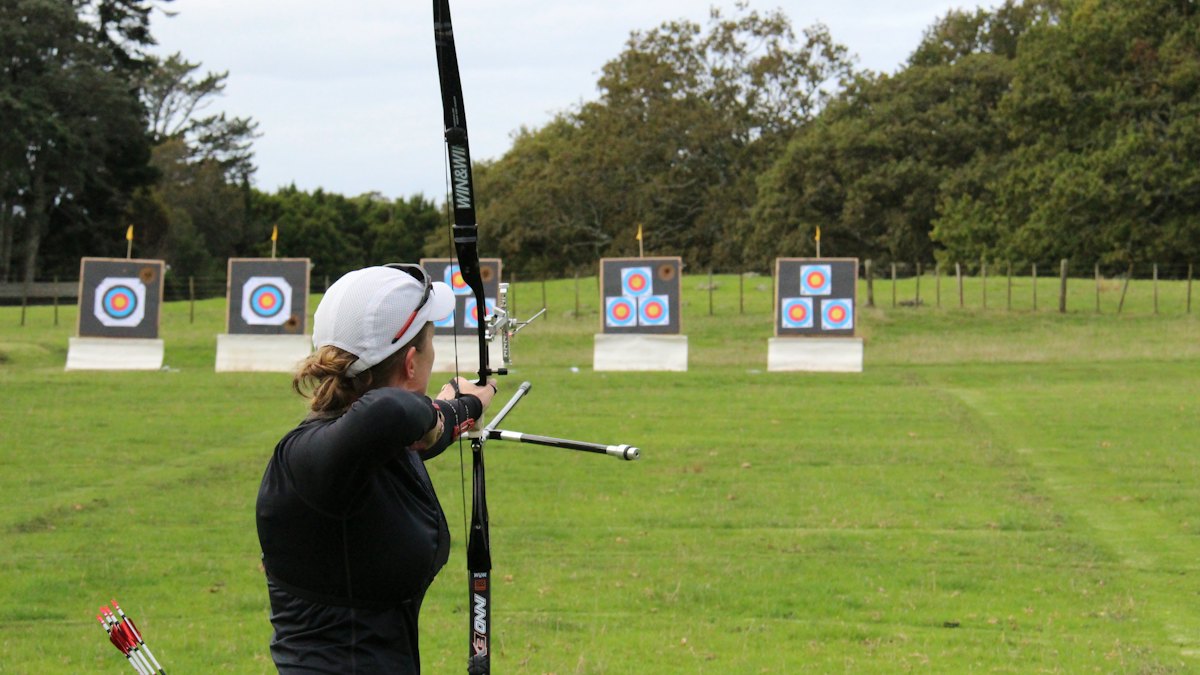
The third audience is the indoor target shooter, and it is the one place where aluminum still outsells carbon outright. Fat codes — 2315, 2314, and the 2215 — maximize scoring-ring contact; a 23/64″ shaft touches nearly a quarter inch more of the ring line than a slim carbon. Indoors, distance is fixed and wind is absent, so the aluminum weight penalty costs nothing and the diameter advantage compounds over every end. This is why pro shops still stock fresh 23-series aluminum even as the hunting racks went full carbon.
Best Aluminum Arrow for a 65 lb Compound
The classic scenario, run through the page's own logic. A 65 lb compound shot with a mechanical release, 28–29″ arrows and a 100–125 gr point lands at an effective weight the picker matches to the 2219 as primary — ≈ 300 carbon band, ≈ 0.28–0.30″ published deflection, ≈ 22 GPI of manufacturer-published nominal mass — with the 2216 as the softer alternate and the 2317 as the stiffer one. The best spine aluminum arrow for a 65lb compound is therefore not a single number but a short decision path:
- 28″ arrows, 100 gr points: 2219 primary. The archetypal match — heavy, forgiving, indestructible by aluminum standards.
- 30″+ arrows or points under 100 gr: shift softer to 2216. Long arrows act weak, and the release-aid launch is already doing the 2219 no favors at the stiff end of its band.
- 27″ or shorter arrows with 150+ gr broadheads: shift stiffer to 2317. Short-and-heavy builds act stiff, and the 2317's fat diameter helps recovery.
- East-coast whitetail at 60–62 lb instead: the 2216 primary with 2219 alternate — don't over-stiffen a lighter rig to feel safe.
The aluminum-specific bonus at this band: hunting-weight arrows come free. A 30″ 2219 with standard components already lands in the 500-grain class without screw-on weights, which is exactly the momentum range a 65 lb bow converts into penetration. Verify the direction with one bare shaft on paper before buying the dozen — the conversion bands are approximate, and your bow's arrow length and point weight are the two inputs that decide which side of ≈ 300 you actually land on.
Frequently Asked Questions
Do aluminium arrows have a spine?Top Question▼
Yes — every shaft has a spine, aluminum or carbon. The difference is labeling: carbon arrows are sold by a 3-digit deflection number (400, 500, 600), while aluminum arrows encode their stiffness inside the 4-digit size code, because wall thickness and tube diameter define the deflection. A 1916 and a 2219 differ in spine exactly as much as their published deflections differ (≈ 0.44–0.46″ versus ≈ 0.28–0.30″ under the standard ASTM-style test). So when a chart asks for your arrow's spine and you shoot aluminum, you read it off the size code using the decoder table on this page — the number was printed on the shaft all along.
What is the arrow spine deflection of 1916?Top Question▼
The published nominal deflection of a 1916 aluminum shaft is approximately 0.43–0.46″ under the standard deflection test — manufacturer-published values vary slightly between production eras, hence the range. That places the 1916 almost exactly on the 500-spine carbon band, which is why the 1916↔500 conversion is the single most quoted aluminum-to-carbon equivalent in archery. Practical window: 30–45 lb finger-release recurves and light compounds at average arrow lengths, stretching toward 50 lb if you cut short and use light points.
What arrow spine is equivalent to 2016?Top Question▼
A 2016 aluminum shaft corresponds to approximately a 400-spine carbon arrow — the nominal 0.39–0.41″ deflection sits squarely on the 400 band. The equivalent set is worth memorizing: 1916 ≈ 500, 2016 ≈ 400, 2117 ≈ 350, and 2219 ≈ 300. Two caveats keep the conversion honest. First, aluminum runs a fraction heavier per spine than carbon, so speed drops a few fps at the same match. Second, the equivalence is static: a fat aluminum tube recovers differently in flight than a slim carbon, so always bare-shaft confirm before buying a dozen.
What spine is Easton 2219 aluminum?▼
The 2219 is the stiff end of the classic hunting ladder: a nominal deflection of ≈ 0.28–0.30″, which maps to the 300-spine carbon band. Read the code and the stiffness explains itself — 22/64″ of diameter with 0.019″ of wall is a lot of aluminum, and a lot of aluminum is a stiff, heavy shaft (≈ 22 GPI class, manufacturer-published nominal values). It earned its legend status serving 55–70 lb compound bows and heavy traditional builds for decades, and it is still the default answer when someone asks what to shoot from a 65 lb draw.
What is the Easton 1820 arrow spine?▼
The 1820 publishes a nominal deflection of approximately 0.44–0.46″ — same outside diameter as the 1816 (18/64″), stiffened by the thicker 0.020″ wall, which also adds weight and durability. On the carbon scale it converts to roughly the 500–550 band, sitting between the 1816 (≈ 600) and the 2016 (≈ 400). Its natural audience is 35–45 lb recurves and light compounds, and it remains popular for traditional builds where a slightly heavier shaft quiets the launch off the shelf.
Easton XX75 500 arrow spine deflection — which shaft is that?▼
This query mixes two naming systems. Easton XX75 aluminum shafts never carried a '500' label — their sizes are 4-digit codes (1916, 2018, 2219) that you decode with the table on this page. The '500' number is the carbon-era deflection scale. The XX75 shaft that matches a 500-class deflection is the 1916 (≈ 0.43–0.46″ published nominal), with the 1816 one step softer at ≈ 0.47–0.49″ (≈ 600 class). So if a listing says 'the aluminum equivalent of a 500 spine,' the answer you want on the XX75 shelf is 1916 — or 1820 if you want the same stiffness in a slightly heavier tube.
What is a 300 spine arrow in Easton XX75 terms?▼
The 300-spine carbon band (0.300″ nominal deflection) corresponds to the Easton XX75 2219 — published deflection ≈ 0.28–0.30″ — with the 2317 (≈ 0.29–0.31″) as the large-diameter near-twin. Both are thick-walled, heavy shafts built for 60–70 lb draw weights. Note the direction of the numbers: lower deflection equals stiffer, so '300' is a stiff hunting grade, not a light one. If your bow is under 60 lb, step down the ladder to 2216 (≈ 340) or 2117 (≈ 350) instead of forcing a 300-class aluminum to work.
Do 600 and 700 spine aluminum arrows exist? What about 700-class shafts?▼
Yes — you just have to read them in code. A '600 spine aluminum arrow' is an 1816 (≈ 0.47–0.49″ deflection), and 700-class aluminum lives in the 1716 and its thinner-walled 17/64″ cousins (≈ 0.49–0.51″). These light grades serve 25–40 lb recurves, strong youth bows, and camp programs. What you will not find is a shaft labeled '700' in an aluminum catalog, because aluminum never adopted the 3-digit deflection label — so buyers searching for aluminum arrow shafts in 700 spine should shop by decoded deflection instead of by the number on the box.
What is the best spine aluminum arrow for a 65 lb compound?▼
Start at the 2219 and confirm from there. A 65 lb compound with a 28–29″ arrow and a 100–125 gr point lands at an effective weight that the picker on this page matches to the 2219 (≈ 300 carbon band) as primary, with 2216 as the softer alternate if your arrows run long (30″+) or your points run light. If you shoot 27″ arrows with heavy 150+ gr broadheads, the 2317 is the stiffer direction. Aluminum gives a 65 lb hunter a bonus carbon rarely matches at this band: the mass is already in the wall, so no lag bolted inserts are needed to hit hunting-weight arrows.
Can you straighten a bent aluminum arrow — and should you?▼
You can, and unlike carbon (which hides internal damage), a bent aluminum shaft shows you exactly what happened. A gentle bow in the shaft's mid-section can be rolled out on a straightener and the arrow returns to service. The two disqualifiers: a crease or flat-spot (wall integrity is gone) and ovalization — when the tube's round cross-section has gone slightly egg-shaped from a hard hit, straightening the bend does not restore the roundness, and the shaft's deflection has silently changed. Spin-test on a flat table after every impact; if the tip describes a visible orbit, retire the shaft.
How do I use an aluminum arrow spine conversion chart without getting burned?▼
Treat every conversion as a starting point plus a verification step. The nominal deflections in this page's table are manufacturer-published values, and they map cleanly to carbon bands — 1916 ≈ 500, 2016 ≈ 400, 2219 ≈ 300 — but three variables move the real-world match: cut length (±2.5 lb of effective weight per inch), point weight (±25 gr ≈ half a grade), and release style (fingers vs release ≈ half to one grade). Convert with the chart, adjust with the picker at the top of this page, then buy one bare shaft and confirm on paper before committing to a dozen. That sequence is the whole conversion chart used correctly.
From Code to Purchase in Four Steps
The whole system compresses into four moves. One: decode — read the first two digits as 64ths of an inch and the last two as thousandths, or use the dashboard at the top of this page. Two: match — find your effective draw weight's band in the chart, adjusted for arrow length, point weight and release style. Three: convert — if you shoot or shop in carbon numbers, read the carbon-equivalent column so both vocabularies agree. Four: confirm — one bare shaft on paper before a dozen, because every value here is a manufacturer-published nominal (≈) and your bow is the final authority.
This page owns the number system: what 1716 through 2317 mean, how they convert, and how they flex. The product-line decision — which current or vintage Easton series, and how it compares against modern carbon lines shaft-for-shaft — lives on the Easton Arrow Selector, which decodes the same classics (2013, 2219) from the brand side and links back here for the digit math. Between the two pages, every layer of the aluminum question is covered once and only once.
Related Arrow Tools & Guides
Arrow Spine Chart
Free 2026 arrow spine chart and interactive calculator. Inst...
Arrow Kinetic Energy Calculator
Arrow kinetic energy calculator: enter arrow weight and spee...
Bow Draw Length Calculator
Bow draw length calculator: enter wingspan to get draw lengt...
Arrow Spine Calculator
Arrow spine calculator: enter bow type, draw weight, draw le...
Arrow FOC Calculator
Arrow FOC calculator: enter arrow length and component weigh...
Arrow Weight Calculator
Arrow weight calculator: pick shaft GPI, cut length, point, ...
Arrow Trajectory Calculator
Arrow trajectory calculator: enter arrow speed, weight, dist...
Bow Draw Weight Calculator
Bow draw weight calculator by age, build, experience and gam...
Crossbow Ballistic Calculator
Crossbow ballistic calculator: bolt speed, drop and kinetic ...
Compound Bow Arrow Chart
Official compound bow arrow spine chart. Quickly match arrow...
Easton Arrow Selector
Free 2026 Easton arrow selector and shaft spine calculator. ...
Gold Tip Arrow Calculator
Calculate your exact Gold Tip arrow spine size or view the o...
400 Spine Arrows
400 spine arrows: fit windows for 45-60 lb compound and 40-5...
500-1400 Spine Arrows
500 to 1400 spine arrows by draw weight: 500 spine for 40-50...
Brand Spine Chart Decode
Decode spine charts for Blackout, Bloodsport, Beman, Sirius,...
Wood Arrow Spine Calculator
Wood arrow spine calculator: pick bow type, draw weight, arr...
Do Arrows Spin in Flight? Arrow Rotation Physics Explained
Flight-physics explainer of arrow rotation: why bows add no ...
What Is Arrow Spine? Numbers, Ratings & Stiffness Explained
Concept pillar for arrow spine: the AMO 1.94 lb / 26 inch de...
Weak vs Stiff Arrow Spine: Symptoms, Flight Signs & Fixes
Full diagnosis manual for weak vs stiff arrow spine: symptom...
Recurve Arrow Spine: Recurve, Longbow & Horsebow Guide
Traditional-bow spine selection guide: finger-release dynami...