400 Spine Arrows: Draw Weight Chart & Spec Comparison
The default grade for 55–65 lb compounds and 45–55 lb recurves — compared model by model in the 400-spine model matrix below: Easton Axis, 6.5 and 5.0, Gold Tip Hunter, Carbon Express Maxima and Victory VAP by GPI, straightness and finished weight. If you want the interactive fit diagnosis instead — type your draw weight, length and point weight and get a grade verdict — use the 400 spine arrow tool; this page is the buying guide that explains what the numbers mean.
400 Spine Arrows for Sale: The 55–65 lb Default Grade, Explained

Search “400 spine arrows for sale” and you get thousands of listings with almost no guidance about which shaft fits your bow. Here is the frame that makes the listings readable: 400 spine (0.400″ AMO deflection) is the default carbon arrows 400 spine grade for 55–65 lb compound bows and 45–55 lb recurves at typical draw lengths and point weights. It is the most-sold arrow grade in archery because it covers the center of the bell curve — the 60 lb whitetail rig, the 55 lb beginner compound, the 50 lb traditional bow. Every 400 spine arrow shaft on this page is a carbon construction (aluminum-jacket models excepted), because carbon arrows 400 spine dominate the modern market in both hunting and target disciplines.
Three numbers decide whether a specific 400 spine arrow flies correctly on your bow: draw weight (the engine), draw length / cut length (the lever arm), and point weight (the front load that softens dynamic spine). Get those three right and nearly every quality 400 shaft on the market tunes cleanly; get one wrong by a full step and no brand rescues you. The quick lookup version of this page lives on the Arrow Spine Chart, and the full mechanics of deflection, dynamic spine, and weak-vs-stiff tear patterns are on the Arrow Spine Calculator page. This guide stays in buying territory: which 400 models exist, what they weigh, and which one matches your use.
💡 The 100-grain default: most 400 buyers should start from the anchor spec — 60 lb, 29″ draw, 100 gr point — and adjust one variable at a time. Nearly every fit question on this page resolves to “half a grade per step”: +1″ of draw or +50 gr of point weight each moves you half a grade stiffer (toward 340); the reverse moves you toward 500.
The 400-Spine Model Matrix: Easton, Gold Tip, Maxima and VAP
The matrix below is the content anchor of this page: easton 400 spine carbon arrows and gold tip arrows 400 spine models side by side with Carbon Express and Victory, ranked by the three specs that actually differ between brands — GPI (shaft weight per inch), straightness tolerance, and finished weight at a 29″ cut with a 100 gr head. Use the filter to narrow the field to your purpose. GPI values are manufacturer-published nominal values (±0.2 by production year); finished weight assumes standard insert/nock/vane hardware at ≈35 grains. Confirm the current spec sheet before ordering a dozen, and deflection-match mixed brands on the Arrow Spine Comparison page.
| Model (400 spine) | GPI | Straightness | ≈ Finished weight @ 29″ + 100 gr | Shaft class | Best at | Pick |
|---|---|---|---|---|---|---|
| Easton Axis 5mm 400 | ≈ 9.0 | ±0.006″ (match ±0.003″) | ≈ 395 gr | 5mm micro-diameter, match-grade carbon | All-round hunting benchmark — deer to elk at 55–65 lb | ✓ Winner |
| Easton 6.5 400 | ≈ 8.7 | ±0.004″ | ≈ 385 gr | 6.5mm standard-diameter hunting carbon | Widest component stock, forgiving all-round deer shaft | Solid |
| Easton 5.0 400 | ≈ 8.2 | ±0.006″ | ≈ 370 gr | 0.204″ micro-diameter, speed-weight balance | Lightest serious 400 — speed-minded builds and 3D crossovers | ★ Value |
| Gold Tip Hunter 400 | ≈ 8.2 | ±0.003″ factory | ≈ 370 gr | 0.246″ standard diameter, thick-wall durability | Rocky-country durability and the best warranty in the class | ✓ Winner |
| Carbon Express Maxima Red 400 | ≈ 8.6 | ±0.0039″ | ≈ 385 gr | 0.246″ standard diameter, fused Red-Zone rear | Point-weight-forgiving tuning for whitetail | ✓ Winner |
| Victory VAP 400 | ≈ 8.2 | ±0.006″ (V1 ±0.002″) | ≈ 370 gr | 0.204″ micro target-hunting hybrid | Tightest-tolerance dozen for target and field rounds | Solid |
| Victory Rip TKO Sport 400 | ≈ 8.9 | ±0.006″ | ≈ 395 gr | 0.204″ small-diameter, thick wall | Wind-bucking small diameter for 3D-to-hunt dual use | ✓ Winner |
| Bloodsport Hunter 400 | ≈ 8.7 | ±0.006″ | ≈ 385 gr | 0.246″ standard-diameter budget carbon | Value dozen for hard practice use that tunes honestly | ★ Value |
Finished weight = 29″ shaft + 100 gr head + ≈35 gr of insert/nock/vanes. Straightness figures are factory-published tolerances; some lines offer tighter match-grade options. Verify any mixed-brand quiver with a spine tester before tuning.
400 Spine Arrow Draw Weight: The 55–65 lb Window
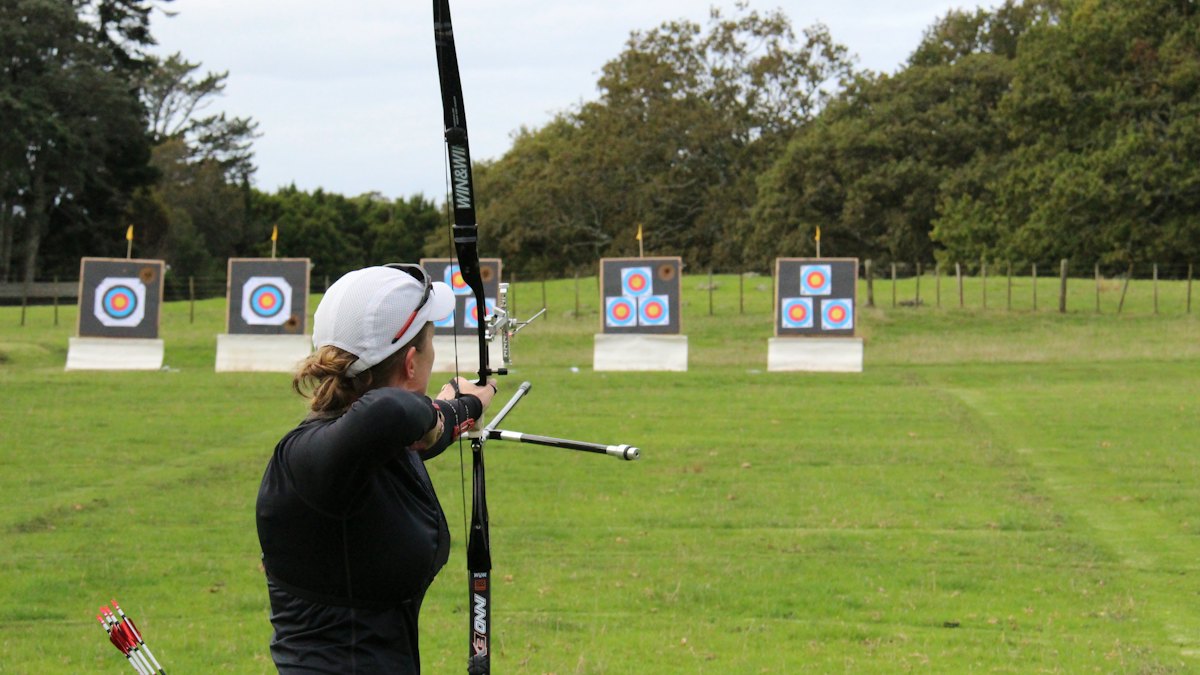
The question behind every “400 spine arrows draw weight” search is really three questions in one, because 400 spine arrow draw weight is not a single number — it is a window defined by draw length and point weight. The anchor: a 60 lb compound at a 29″ draw with a 100 gr point is a textbook 400 fit. From that anchor, each +1″ of draw length moves you about half a grade stiffer (toward 340), and each +50 gr of point weight does the same; each step in the opposite direction moves you half a grade softer (toward 500). The table below shows the whole window for the 55–65 lb compound class.
| Draw length ↓ / Point weight → | 85 gr | 100 gr | 125 gr | 150 gr |
|---|---|---|---|---|
| 27″ | 500 | 500 | 400 | 400 |
| 28″ | 400 | 400 | 400 | 340 |
| 29″ | 400 | 400 | 340 | 340 |
| 30″ | 400 | 340 | 340 | 340 |
Calibrated for a 60 lb compound, moderate cam, release aid. 55–56 lb shooters: shift one cell softer; 63–65 lb shooters: one cell stiffer; finger release: one cell stiffer. Boundary cells (400 next to 340/500) are one-shaft paper-tune territory.
Arrow Spine for a 50 lb Compound
A 50 lb compound sits below the 400 window at standard specs — the correct arrow spine for a 50 lb compound at 27–29″ with a 100 gr point is 500, one full grade softer. 400 only enters the conversation at 50 lb when two softening factors stack: a 150–200 gr traditional-style head plus a long 29–30″ draw, or a finger-release grip on a compound. Even then, the honest answer is a test shaft, not a purchase — a 50 lb bow driving an over-spined 400 prints stiff-side tears (tail-right) and groups unpredictably past 30 yards. Light-draw shooters get their full model breakdown on the 500 Spine Arrows guide, which covers the 40–50 lb compound and recurve class in the same matrix format as this page.
A 400 Spine Arrow on a 60 Pound Bow
When does a 400 spine arrow 60 pound bow combination still work at the edges? Three cases: (1) short draw — a 60 lb bow at a 26–27″ draw is a 400/500 boundary case, and the 400 works if you keep the point at 100–125 gr and paper-tune; (2) light point — 85–90 gr field points soften the demand, keeping a 60 lb / 30″ setup inside 400; (3) stiff-side tolerance — bows with aggressive hard cams load the shaft harder and effectively weaken dynamic spine, so a 60 lb hard-cam bow at 29″ with 125 gr runs closer to 340 than the table suggests. Outside those cases, the 60 lb anchor stands: 400 at 29″ + 100 gr, adjusted one half-grade per variable. If your 60 lb rig carries a 150 gr elk head, stop reading this page and check the crossover thresholds on the Arrow Spine Comparison page first.
A 400 Spine Arrow on a 70 Pound Bow: The Correction to 340
This is the most common mistake in the 400 grade, so it gets its own section. Many charts and product pages label 400 as covering “up to 70 lb,” and buyers trust the label. The physics disagrees. A 400 spine arrow 70 pound bow combination fails dynamically at standard specs: at 29″ with a 100 gr point, a 70 lb power stroke needs a 340. The mechanism is dynamic spine — the shaft flexes around the riser at launch, and flex amount scales with stored energy. Ten extra pounds of draw weight adds roughly a full grade of stiffness demand: the 400 that flexed perfectly on your 60 lb friend's bow flexes past the riser on yours, prints 4–6 inch tail-left tears on bare paper, and groups field points left of broadheads at 30 yards. Charts show overlap at the boundary because manufacturers grade in static deflection steps; the bow grades in energy.
The full model-by-model fix for the 70 lb class — Easton Axis and Gold Tip Hunter 340, the Victory/CE 350 equivalents, and the long-draw handling rules — lives on the 340 & 350 Spine Arrows guide. And if you would rather have the verdict computed from your exact draw weight, draw length, point weight and cam type, the 400 spine interactive checker on the tool page grades your setup and tells you whether to stay on 400, correct to 340, or drop to 500. Two pages, one job: this one explains, that one diagnoses.
❌ Don't buy the label, buy the deflection: a chart cell that says “400: 55–70 lb” describes the widest static window any setup in that band could theoretically tune into — not your setup. At 70 lb / 29″ / 100 gr the dynamic answer is 340 in the overwhelming majority of bows. If a listing's only fit evidence is a wide draw-weight range, treat the bottom of the range as the real window.
⚠️ The broadhead multiplier: the 70 lb error compounds with head weight. A 70 lb bow at 29″ shooting a 125 gr fixed broadhead on a 400 is effectively 1.5 grades over-spined — the tail-left tear grows and fixed blades plane harder than field points. Correcting with point weight (adding more gr to soften) backfires past about 150 gr, because the extra front mass that softens spine also drags FOC and flight characteristics off spec. Change the grade, not the patch.
28-Inch 400 Spine Arrows: What the Cut Changes
28 inch 400 spine arrows are the single most common finished length in the grade, because a 28″ draw shooter and a 29″ draw shooter both land near that cut once point-end hardware is accounted for. The cut length matters mechanically: a shaft stiffens by roughly half a grade for every inch trimmed, so a 400 cut to 28″ behaves like a 380–390-class shaft dynamically. That is why the fit table above shows 28″ rows tolerating more point weight than 27″ rows at the same draw weight. Two practical rules follow. First, buy raw shafts long enough to trim: most 400s come 32″ raw, which covers cuts from 26″ to 31″ — but confirm raw length before ordering, because a few speed-series 400s ship at 30″ raw and leave no room for a long-draw correction. Second, cut once: measure with broadhead and insert installed, then trim — you cannot uncut a carbon shaft, and re-cutting a dozen shorter after a fitting mistake turns a 400 into a 350-behaving mystery. Run the finished-weight consequences of your cut on the Arrow Weight Calculator — every inch trimmed removes roughly one GPI worth of grains, which changes speed, GPP, and the IBO minimum-weight floor together.
400 Spine Arrows for Recurve and Traditional Bows
400 spine arrows for recurve serve the 45–55 lb traditional class — the heart of recreational traditional shooting — and 400 spine traditional arrows are equally common on 55–60 lb longbows with heavier heads. The one correction every recurve shooter must apply: finger release weakens dynamic spine by about half a grade, because the string rolls off three fingers instead of releasing from a containment aid. A 50 lb recurve therefore fits roughly where a 55 lb compound fits. Practical fits: 45 lb recurve at 28″ with a 100 gr point — 400/500 boundary, test both; 50 lb recurve at 28″ with a 125 gr point — clean 400; 55 lb recurve at 28″ with a 150 gr head — solid 400; 60 lb recurve at 30″ with a 125+ gr head — 400, sometimes 340. Traditional builds also run higher FOC naturally (a 150–175 gr field point on a 28″ shaft is 15–19% FOC without inserts), and the shafts that handle it best in this matrix are the Maxima Red 400 (fused stiff rear section resists finger-release tail flex) and the Gold Tip Hunter 400 (thick wall survives the harder impacts traditional ranges produce). Feather fletching, tapered nocks, and full traditional-setup guidance are on the 500 Spine guide, which shares the traditional fit logic one grade softer.
The Best 400 Spine Arrows by Use Case
“Best 400 spine arrows” has no single answer, but it has four, one per use case — and the matrix above backs each pick with GPI and straightness rather than adjectives. The best 400 spine hunting arrow for all-round deer and elk at 55–65 lb is the Easton Axis 5mm 400: ≈9.0 GPI builds a 395-grain finished arrow that carries momentum through shoulder blades, the micro diameter bucks crosswind at 40 yards, and match-grade availability (±0.003″) keeps a dozen flying as one. For rocky-country durability, the Gold Tip Hunter 400 wins: same functional fit at ≈8.2 GPI, ±0.003″ factory straightness, a thick standard-diameter wall, and a warranty that actually pays out. For tuning forgiveness — shooters who swap between 100 gr field points and 125–150 gr broadheads seasonally — the Carbon Express Maxima Red 400 holds its tune across the widest point-weight band in the class. For target and field rounds, the Victory VAP 400 delivers dozen-to-dozen consistency at ±0.006″ with a ±0.002″ V1 upgrade path, and the Easton 5.0 400 is the value-minded light micro for 3D courses where every fps counts. For 3D-to-hunt dual use, the Victory Rip TKO Sport 400 combines a wind-bucking 0.204″ diameter with a thick wall, at ≈8.9 GPI. Whatever you pick, verify the pick against your own bow with the homepage arrow spine calculator before ordering a dozen — it costs nothing and catches the boundary cases the matrix cannot see.
The Best Arrow Spine for a 60 lb Bow
Compressing the whole page into one answer: the best arrow spine for a 60lb bow is 400 for the standard 28–29″ draw with 100–125 gr heads, drifting to 340 only when a 30″ draw or a 150 gr head enters the setup, and to 500 at a 26–27″ draw with light points. In the matrix terms: a 60 lb shooter at 29″ + 100 gr should buy the Axis 5mm 400 for hunting or the VAP 400 for targets, and expect bare-shaft paper to tune near-perfect with no corrections. The half-grade rules above are the whole difference between the 400 that groups and the 400 that frustrates.
Speed Builds vs Durability Builds in 400 Spine
Within one spine grade, the remaining choice is how you spend the mass budget, and the matrix splits cleanly down the middle. Speed builds take the ≈8.2 GPI shafts — Easton 5.0 400, Victory VAP 400, Gold Tip Hunter 400 — finished near 370 grains with a 100 gr head. From a 60 lb bow that is roughly 285–295 fps, with visibly flatter 20–40 yard pin gaps and about 8–12 fps more than the heavy builds; the cost is wall thickness, because the light micros dent on steel targets and rock impacts and reward a spin-test habit. Durability builds take the ≈8.7–9.0 GPI shafts — Axis 5mm 400, Rip TKO Sport 400, Maxima Red 400 — finished at 385–395 grains, trading roughly 10 fps for thicker walls, more momentum (≈0.66 vs ≈0.62 lb·s at comparable speeds), and better behavior in wind. Neither is “better”: a 3D shooter and a backcountry elk hunter are optimizing different variables. What both share is the 400 spine itself — inside the 55–65 lb window, the grade is not the variable; the construction is. Price the trade in grains and fps on the Arrow Weight Calculator, and check the grade boundary one last time on the spine comparison page before you commit.
💡 The dozen-rule: whichever build you choose, buy all twelve from the same production lot (same model, same year, one order). A 400 spine dozen mixed from two purchases can span ±0.004″ of straightness and ±3 grains of shaft weight — small numbers that show up as a 6-inch vertical spread at 50 yards and a frustrating afternoon of re-tuning.
400 Spine Arrows: Frequently Asked Questions
Can a 70 pound bow shoot 400 spine arrows?Top Question▼
Almost never — a 70 lb bow at the standard 29″ draw with a 100 gr point is a 340 bow, one full grade stiffer than 400. Dynamic spine is what matters: the 70 lb power stroke flexes a 400 shaft past the riser and prints tail-left tears 4–6 inches long on bare paper. The narrow exceptions: cut the arrow to 27″ or less, drop to an 85 gr point, and shoot a smooth moderate cam — and even that combination sits on the 400/340 boundary, so it needs a one-shaft paper tune before you buy a dozen. If your 70 lb setup carries a 125–150 gr broadhead or a 30″ draw, the answer moves from 340 toward 300. Buy 340 first; see the correction logic in the 70 lb section above.
Can a 60 pound bow shoot 400 spine arrows?Top Question▼
Yes — 60 lb at a 29″ draw with a 100 gr point is the textbook anchor fit for 400 spine. The full 400 window at 60 lb runs roughly 27–30″ of draw with 85–150 gr points, as long as you shift half a grade for each step: a 27″ draw or an 85 gr point drifts toward 500, a 30″ draw or a 150 gr head drifts toward 340. A 60 lb bow shooting a 125 gr fixed broadhead at 29″ sits right on the 400/340 line — split the difference by paper-tuning one uncut shaft of each grade. For most 60 lb whitetail rigs (28–29″, 100–125 gr), 400 is the correct first purchase.
What about 28 inch 400 spine arrows — does the short cut change the fit?Top Question▼
Yes, and in your favor. Cutting a 400 shaft from its 32″ raw length to 28″ of finished arrow stiffens its dynamic spine by roughly half a grade, because a shorter column resists bending more than a long one. That means 28 inch 400 spine arrows fit slightly heavier setups than the same shaft at 30″: a 62–65 lb compound at 28–29″ with a 100–125 gr head is a clean 400 fit, where a 30″ version of the same arrow would want 340. The flip side: if your bow is a 55–56 lb shooter at a 27″ draw, a 28″ cut 400 is already a half grade too stiff — that is 500 territory. Rule of thumb: every inch you cut recovers about half a grade of stiffness.
What is the best 400 spine hunting arrow?▼
For the widest range of 55–65 lb hunters, the Easton Axis 5mm 400 is the benchmark: ≈9.0 GPI puts a 29″ shaft near 395 grains finished with a 100 gr head, ±0.006″ straightness (±0.003″ in match grade) keeps dozens consistent, and the micro diameter resists crosswind. The Gold Tip Hunter 400 is the durability pick — same functional fit, ±0.003″ factory straightness, and the strongest damage warranty for rocky terrain. The Carbon Express Maxima Red 400 is the tuning-forgiveness pick for shooters who switch point weights. All three paper-tune identically on a bow that genuinely calls for 400; choose by wall thickness, straightness tolerance, and warranty, not marketing.
Easton Axis 400 vs Easton 6.5 400 vs Easton 5.0 400 — what is the actual difference?▼
Diameter, wall thickness, and weight. The Axis 5mm 400 is a 5mm (0.204″) micro-diameter match-grade shaft at ≈9.0 GPI — the heaviest and most wind-resistant of the three. The 6.5 400 is a 6.5mm standard-diameter hunting shaft at ≈8.7 GPI with ±0.004″ straightness and the deepest component and insert stock of any Easton line. The 5.0 400 is the 0.204″ micro speed build at ≈8.2 GPI — about 25 grains lighter finished than the Axis, worth roughly 6–8 fps, at the cost of thinner walls. All three carry the same 400 spine deflection, so the bow cannot tell them apart; your choice is mass budget versus speed budget versus component availability.
Are Gold Tip Hunter 400 spine arrows any good?▼
They are the durability reference point of the entire 400 class. Specs: ≈8.2 GPI, 0.246″ standard diameter, ±0.003″ factory straightness — tighter than most competitors' standard lines — and Gold Tip's warranty covers shafts broken by arrow-to-arrow impacts, which no other manufacturer matches. A 29″ Hunter 400 with a 100 gr head finishes near 370 grains, and the thick standard-diameter wall shrugs off steel-target and rock impacts that dent micro-diameter shafts. The trade: it is one of the lighter 400s, so momentum hunters chasing 400+ grain builds should step to the Axis 5mm 400 or a heavier-GPI shaft instead. For a first serious dozen at 55–65 lb, it is the lowest-regret purchase in the grade.
What draw weight do 400 spine arrows fit on a recurve?▼
400 spine arrows for recurve fit roughly 45–55 lb of draw weight at a 28″ arrow — with one critical correction: finger release weakens dynamic spine by about half a grade, so a recurve needs a stiffer label than an equivalent compound. Practically: a 50 lb recurve at 28″ with a 125 gr point is a clean 400; a 45 lb recurve with a 100 gr point sits on the 400/500 boundary; a 55 lb recurve with a 150 gr head is a solid 400, sometimes 340. The 60 lb recurve with a 125+ gr head also lands on 400, which is why traditional shooters commonly buy it. Full traditional setups, taper tables, and feathered configurations live on the 500 spine guide for lighter bows.
What is special about Carbon Express Maxima 400 spine arrows?▼
The Maxima Red 400 (≈8.6 GPI, ±0.0039″ straightness, 0.246″ diameter) carries Carbon Express's signature Red-Zone technology: the rear third of the shaft is a bonded, deliberately stiffer section. Because most launch-flight failures start with the tail over-flexing, stiffening the tail lets the shaft run a slightly softer overall rating while launching straighter — Carbon Express claims a wider tune window and less sensitivity to point-weight changes, which is exactly what a shooter who experiments with 100–150 gr heads wants. Two handling rules: cut from the point end only (the nock-end cut destroys the Red Zone), and expect Carbon Express-specific component stock rather than universal Easton/Gold Tip fittings. Each shaft ships with a BullDog nock collar for impact reinforcement.
What is the best arrow spine for a 60 lb bow?▼
For a 60 lb compound at 28–30″ of draw with 100–125 gr heads, the best arrow spine is 400 — it is the single most-sold grade in archery for exactly this reason. Adjust from the anchor (60 lb / 29″ / 100 gr): add a 150 gr broadhead or draw 30″ and the correct spine drifts to 340; shorten to 27″ or drop to an 85–90 gr point and it drifts to 500. For a 60 lb recurve or longbow, the finger release shifts the answer one label stiffer: 400 with a 100–150 gr point at 28–30″. Verify the borderline cases with one paper-tuned test shaft per grade rather than trusting any chart label.
How much does a 400 spine arrow weigh?▼
Shaft-only, 400-grade carbon runs 8.2–9.0 GPI across the main hunting models — about 238–261 grains at a 29″ cut. Finished with a 100 gr head plus roughly 35 grains of insert, nock, and vanes: the light micro builds (Easton 5.0, Victory VAP, Gold Tip Hunter) land near 370 grains, the standard hunting builds (6.5, Maxima Red, Bloodsport Hunter) near 385, and the heavy micro Axis 5mm near 395. Add a 125–150 gr head and 50 gr of insert weight and the same shafts reach 420–465 grains. That 370–465 band clears the 5 grains-per-pound safety floor at every draw weight the 400 grade serves, while keeping speed in the 270–295 fps range from a 60 lb bow.
Related Guides & Tools
01400 Spine Arrows
400 spine arrows: fit windows for 45-60 lb compound and 40-55 lb recurve, when a 60 or 70 ...
02500-1400 Spine Arrows
500 to 1400 spine arrows by draw weight: 500 spine for 40-50 lb recurve, 600-900 for youth...
03Brand Spine Chart Decode
Decode spine charts for Blackout, Bloodsport, Beman, Sirius, Skylon and more: brand number...
04500 Spine Arrows: Recurve, Traditional & Light Compound
Step-by-step 500 spine buying guide: fit-window derivation for 40-50 lb recurve and light ...
05600 & 700 Spine Arrows: Light Bows, Youth & Barebow
Scenario-card guide to the light grades: 600 vs 700 spine differences and conversion, feat...