340 & 350 Spine Arrows: Spec & Grain Comparison (Hunting & Target)
The grade most hunters actually buy — Easton and Gold Tip call it 340, Victory and Carbon Express call it 350 — compared model by model in GPI, straightness, diameter and finished weight, with deer build windows from 290 to 470 grains.
| Model | Grade | GPI | Diameter | Straightness | Finished (29″+100 gr) | Best at | Pick |
|---|---|---|---|---|---|---|---|
| Easton Axis 5mm 340 | 340 | 9.0 | 0.204″ micro | ±0.006″ (match ±0.003″) | ≈ 395 gr | Benchmark micro hunting shaft — deer to elk | ✓ Winner |
| Gold Tip Hunter 340 | 340 | 8.3 | 0.246″ standard | ±0.003″ factory | ≈ 375 gr | Durability + warranty, rocky country | ✓ Winner |
| Easton 6.5 340 | 340 | 8.7 | 0.246″ standard | ±0.004″ | ≈ 385 gr | Widest accessory stock, all-round deer | Solid |
| Easton 5.0 340 | 340 | 8.1 | 0.204″ micro | ±0.006″ | ≈ 370 gr | Lightest serious 340 — speed-minded builds | ★ Value |
| Gold Tip Pierce Platinum 340 | 340 | 9.5 | 0.204″ micro | ±0.001″ | ≈ 410 gr | Tournament-tolerance heavy micro | Solid |
| Victory VAP 340 | 340 | 8.5 | 0.204″ micro | ±0.006″ (V1 ±0.002″) | ≈ 380 gr | Micro accuracy at standard price | Solid |
| Carbon Express Maxima Red 350 | 350 | 8.9 | 0.246″ standard | ±0.0039″ | ≈ 395 gr | Fused Red-Zone rear — launches straighter | ✓ Winner |
| Victory VAP 350 | 350 | 8.2 | 0.204″ micro | ±0.006″ | ≈ 373 gr | Light micro 350, 58–63 lb bows | Solid |
| Victory Rip TKO Sport 350 | 350 | 9.2 | 0.204″ micro | ±0.006″ | ≈ 402 gr | Small-diameter FOC-friendly 350 | ✓ Winner |
| Bloodsport Hunter 350 | 350 | 8.7 | 0.246″ standard | ±0.006″ | ≈ 387 gr | Value dozen for hard-use deer hunting | ★ Value |
| Black Eagle Deep Impact 350 | 350 | 9.0 | 0.203″ micro | ±0.006″ (±0.001 option) | ≈ 396 gr | Insert-friendly high-FOC 350 | Solid |
| Carbon Express Maxima Red 250 | 340 | 9.8 | 0.246″ standard | ±0.0039″ | ≈ 419 gr | CE's 'heavy' label — measures ≈ Easton 340 | Solid |
GPI values are manufacturer-nominal (±0.2 by production year); finished weight = 29″ shaft + 100 gr head + ≈35 gr of insert/nock/vanes. Amber-highlighted rows are label-drift models — their measured deflection sits on the other side of the 340/350 label boundary. Verify any dozen with the spine tester workflow before tuning.
340 vs 350: One Grade, Two Label Systems

The 340/350 band is the center of gravity of American bowhunting: it fits the 60–70 lb compounds that most deer hunters draw, at the 28–30″ draw lengths most of them have, with the 100–125 gr heads most of them shoot. The confusing part is the naming. Easton and Gold Tip publish 340 as their standard hunting grade; Victory and Carbon Express fill the same slot with 350. Measured on a spine tester, the two labels overlap — a Victory VAP 350 frequently deflects 0.340–0.350″, and the Maxima Red 350 cross-references to Easton's 340 in Carbon Express's own fit charts. So the workable mental model is: 340 and 350 are one grade wearing two name tags. Shop the class by GPI and straightness tolerance, deflection-match anything you mix, and let the paper tune — not the label — confirm the fit.
⚠️ Where the labels genuinely differ: at the exact crossover draw weights (63–64 lb at 29″), a true 0.350″ shaft and a true 0.340″ shaft can land on opposite sides of the tune line. If your bow sits there, the decision is a one-shaft paper tune — the pair-by-pair crossover table on the Arrow Spine Comparison page gives the exact thresholds.
Deer Builds in the 340/350 Class: 290–470 Grain Windows
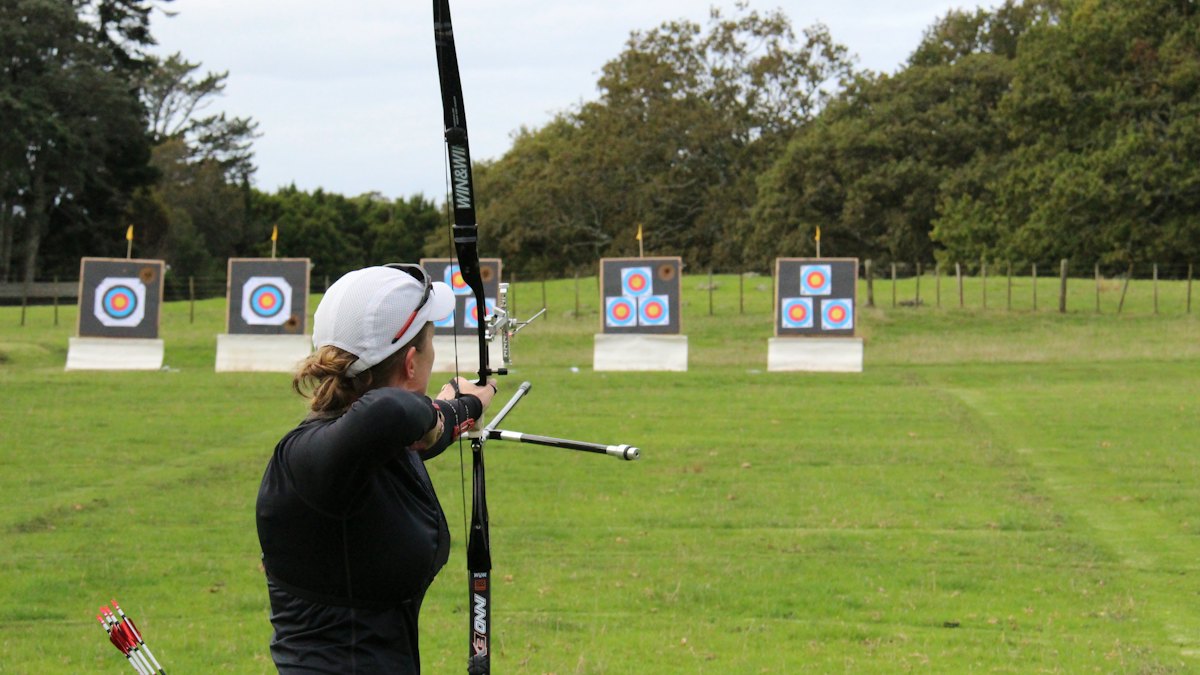
Three proven whitetail configurations cover the class, from the speed end to the heavy-bone end. The finished-weight windows matter because the 5 gr/lb IBO floor scales with draw weight: at 58 lb the floor is 290 grains; at 65 lb it's 325; at 70 lb it's 350 — which is why the lightest window below is closed to 70 lb shooters.
Speed-end deer build (mechanical head)
290–340 gr total60–65 lb · 29″ draw · 340-grade micro (8.1–8.5 GPI) · 100 gr mechanical
The 290–340 grain finished window is the fast flat-shooting end of deer builds — legal above the 5 gr/lb floor only down to 58 lb (58 × 5 = 290). At 65 lb the floor is 325, so most 60–65 lb shooters land 330–345 here.
All-round whitetail build (fixed blade)
375–420 gr total63–70 lb · 28–29″ draw · 340 grade (8.5–9.0 GPI) · 100–125 gr fixed
The default American deer arrow: 375–420 grains at 280–295 fps, 15–18% FOC with a 50 gr brass insert. Penetrates shoulder blades, groups fixed broadheads with field points past 40 yards.
Heavy-bone insurance build
425–470 gr total68–70 lb · 29–30″ draw · 340-grade heavy (9.0–9.5 GPI) · 125–150 gr head
For 30″+ draws and quartering-to shots: this is the top of what the 340/350 class carries before the bow starts calling for 300 spine — check the crossover on the spine comparison page.
Long Draws: Handling 30″+ in the 340/350 Class
Draw length is the quiet spine-killer. Every inch past 30 adds power stroke that weakens dynamic spine by roughly a third of a grade, and long-draw shooters also run longer finished arrows — which is why the same 70 lb bow that cruises on 340 at 28″ needs 300 at 31″. Three levers, in cost order: (1) cut length — an arrow cut to 27.5–28″ recovers about half a grade versus a 30″ shaft, which is often all a 30″-draw 65 lb bow needs to stay on 340; (2) point weight — dropping from 150 to 100 gr recovers half a grade if your game plan allows lighter heads; (3) grade — when a 70 lb, 30″-draw, 125-gr-head shooter paper-tunes tail-right on 340, the honest fix is the 300 class (see the 300 Spine buyer's guide). Long-draw archers should also buy shafts with stock length headroom: many 340s come 32″ raw, leaving nothing to cut for a 31.5″ draw — check raw length before ordering a dozen.
Maxima Red 350 Specs, Decoded
Carbon Express's flagship deer shaft packs three technologies behind one size code. The “350” is the spine class — measuring ≈0.350″ deflection, functionally Easton-340 territory for a 60–70 lb bow. The “Red” refers to the bonded Red-Zone rear section: the tail third of the shaft is deliberately stiffer than the front, because most launch-flight problems start with the tail over-flexing — stiffening it widens the bow's tune tolerance and reduces sensitivity to point-weight changes, which is why the Maxima Red famously “tunes like it's pre-sorted.” The bundled BullDog nock collar reinforces the nock taper against impact splitting. Nominal specs: 8.9 GPI, 0.246″ standard diameter, ±0.0039″ straightness, roughly 395 grains finished at 29″ with a 100 gr head. The trade-offs are real: the fused section adds cost, the shaft can't be cut from the nock end without destroying the zone design (cut front-of-center only), and component stock is Carbon Express-specific. For a 60–70 lb whitetail shooter who wants a shaft that forgives point-weight experiments, it's one of the best-turning standards in the class.
❌ Maxima Red cutting rule: never trim a Red-Zone shaft from the nock end — the fused stiff section lives there, and cutting it off converts a tuned 350 into an untuned mystery. Cut from the point end only, and re-check FOC afterward (the FOC calculator takes 30 seconds).
💡 The one-upgrade rule: if you shoot a package-bow arrow (Trophy Ridge Wrath, Diamond Infinite-class bundles), the single highest-value upgrade is one dozen of Axis 340, Hunter 340, or Maxima Red 350 — factory package arrows are typically standard-grade straightness on generic spines, and the model-matched dozen tightens groups more than any accessory swap at the same price.
Frequently Asked Questions
What's the actual difference between 340 and 350 spine arrows?Top Question▼
On paper, 10 points of deflection — a 340 shaft bends 0.340″ under the AMO test, a 350 bends 0.350″, roughly one-fifth of a grade. In practice the difference is mostly labeling: 340 is the Easton/Gold Tip standard hunting grade, while 350 is the Victory/Carbon Express grade that fills the same 60–70 lb slot in their lineups, and a measured '350' often deflects 0.340–0.355″. Treat them as the same class for bow fitting: 340 or 350 both serve 60–70 lb compounds at 28–30″ draws with 100–125 gr heads. When mixing brands in one quiver, deflection-match them at a spine tester rather than trusting labels — the labels drift, the physics doesn't.
Is a 350 spine arrow the same as a 340? Can I swap them?Top Question▼
Almost always yes within the same brand family and setup, with two checks. First, deflection: measure both shafts at 26″ with a 1.94 lb load — if the 350 reads under about 0.355″, it behaves like a 340 on any bow. Second, weight: a 350 that's 15+ grains lighter per arrow changes your point of impact between brand-mixed arrows, so re-sight after swapping. Where swapping fails: at the exact crossover of a draw-weight band (a 63–64 lb bow), a true 0.350″ shaft can be the wrong side of the line where a 0.340″ tunes clean — that's a paper-tune call, not a label call.
What draw weight uses 340 spine arrows?Top Question▼
The 60–70 lb compound class — the largest hunting demographic there is. Standard fits: 65 lb at 28–30″ draw, 70 lb at 28–29″, 60 lb at 29″ with a 125 gr point or a 30″ draw. Corrections push the boundary in both directions: a 150 gr head or an aggressive cam moves a 70 lb bow to 300; a 27″ draw or a 90 gr point lets a 65 lb bow drop to 400. For recurves and longbows, 340-class shafts fit roughly 55–60 lb off-the-shelf shooters. The 60-second summary: if your compound is the common 60–70 lb deer rig, start at 340/350 and paper-tune to confirm.
What draw weight uses 350 spine arrows — and is it different from 340's range?▼
The same 60–70 lb class, because 350 is that class's label in Victory and Carbon Express lineups. A Victory VAP 350 or Maxima Red 350 fits where an Easton or Gold Tip 340 fits: 60–70 lb compounds, 28–30″ draws, 100–125 gr heads. The practical difference is which brand you're shopping and the small GPI deltas between specific models — the Maxima Red 350 runs 8.9 GPI while a VAP 350 runs 8.2, which matters more day-to-day than the 10-point deflection gap between the labels.
How much does a 340 spine arrow weigh?▼
Shaft-only, 340-grade carbon runs 8.1–9.5 GPI — about 235–275 grains at a 29″ cut. Finished with a 100 gr head and standard components (insert, nock, vanes ≈ 35 gr): micro-diameter light builds like the Easton 5.0 340 land near 370 grains, the benchmark Easton Axis 340 near 395, and the heavy micro Pierce Platinum 340 near 410. That 370–410 finished band is the reason the grade owns deer hunting: it clears the 5 gr/lb IBO floor at every draw weight it serves, while staying fast enough to keep 20-to-60-yard pin gaps manageable.
What are the best 340 spine hunting arrows?▼
Three picks cover almost everyone. Easton Axis 5mm 340 — the micro-diameter benchmark: ±0.006″ straightness standard, huge component ecosystem, and wind-bucking small diameter for open-country deer. Gold Tip Hunter 340 — the durability pick with ±0.003″ factory straightness and the best damage warranty in the business for rocky-terrain hunters. Victory VAP 340 — micro accuracy at a mid price, with a V1 option at ±0.002″ for shooters who sort dozens. Budget-conscious buyers get the Easton 6.5 340 or Bloodsport Hunter for the same functional fit at lower cost. All of them paper-tune identically when the bow actually calls for 340 — buy on straightness tolerance and wall thickness, not marketing.
What is the lightest 340 spine arrow?▼
The micro-diameter speed models: Easton 5.0 340 at about 8.1 GPI (≈ 370 grains finished with a 100 gr head) and Victory VAP 340 at 8.5 GPI (≈ 380 grains finished). That's 15–25 grains lighter than the same-brand Axis or 6.5, worth roughly 4–7 fps at the chronograph. The trade-off is wall thickness — the light micros dent and bend more easily on hard impacts, so they reward the spin-test habit after steel-target sessions. If you want lightweight with maximum toughness instead, the Gold Tip Hunter 340 at 8.3 GPI is within 3 grains of the 5.0 while keeping the thicker standard-diameter wall.
Do Easton 350 spine arrows exist?▼
No — Easton's hunting ladder jumps 400 → 340 → 300, and 350 is the Victory/Carbon Express naming for the same slot. That's why searches for 'Easton 350 spine arrows' dead-end: the shaft those buyers want is Easton's 340. The deflection math backs the equivalence — Victory's 350s typically measure 0.340–0.350″, and Carbon Express's own size chart cross-references its 350 to Easton's 340 in shared draw-weight bands. Shop the class, not the label: a '350' from Victory, a '350' from Carbon Express, and a '340' from Easton all fill the 60–70 lb hunting slot, with GPI and straightness as the real differentiators.
Carbon Express Maxima Red 350 — what do the specs actually mean?▼
The Maxima Red 350 is Carbon Express's flagship 60–70 lb deer shaft: 8.9 GPI nominal, standard 0.246″ diameter, ±0.0039″ straightness, and the line's signature technology — a bonded 'Red Zone' rear section that's deliberately stiffer than the front of the shaft. The engineering idea: most spine-related flight problems come from the tail over-flexing at launch, so stiffening the rear third lets the shaft run a slightly weaker overall rating while launching straighter — Carbon Express claims broader tune tolerance and less sensitivity to point weight changes. Each shaft ships with a BullDog nock collar that reinforces the nock taper. The '350' label measures like an Easton 340 in practice, so fit it to a 60–70 lb bow exactly as you would a 340.
Trophy Ridge Wrath 340 — what arrows does that bow need?▼
The Trophy Ridge Wrath is a ready-to-hunt compound package typically set in the 60–70 lb class with a 26–30″ draw range — squarely 340/350 territory. The factory arrows that ship with such packages are serviceable but usually standard-grade straightness; most shooters upgrade to an Axis 340, Gold Tip Hunter 340, or Maxima Red 350 and immediately gain grouping consistency. Two fitting notes specific to package bows: confirm the actual peak weight with a bow scale (package bows ship with limb bolts backed off, often 5 lb below the sticker), and paper-tune after your first 20 shots as the cables seat — the arrow the package 'includes' and the arrow it 'needs' are frequently one grade apart.
I draw 29–30 inches — are 350 spine arrows still right for a 60–70 lb bow?▼
At 29″, yes — 340/350 is the textbook grade for 63–70 lb. At 30″ the line sharpens: 63–65 lb shooters are now right on the 340/400 boundary (some need 340, some drop to 400 depending on point weight), and 70 lb at 30″ has crossed into 300 territory unless the point stays at 100 gr on a smooth cam. Long-draw shooters also should watch finished arrow length: cutting shafts to 29″+ of exposed length means the GPI you buy is the GPI you shoot — no trim savings. The practical sequence for a 30″ draw: buy one test shaft at 340, paper-tune with your hunting head, and only then decide whether the dozen is 340 or a step to 300/400.
More Arrow Guides & Tools
How to Calculate Arrow Speed
Multi-dimensional comparison of arrow speed calculation meth...
How to Calculate Arrow FOC
Step-by-step SOP guide for arrow FOC calculation: balance po...
How to Calculate Arrow Weight
Scenario-card deconstruction of arrow weight issues: GPI dec...
How to Calculate Arrow Kinetic Energy: KE & Momentum
Decision-dashboard trade-off matrix for arrow kinetic energy...
How to Calculate Arrow Spine: Stiffness & Bow Matching
Step-by-step SOP for arrow spine calculation: static spine (...
How to Calculate Arrow Length: Draw Length & Sizing
First-principles derivation of arrow length: draw length mea...
How to Calculate Arrow Trajectory: Drop, Drag & Wind
Empirical scenario-card analysis of arrow trajectory: parabo...
High FOC Arrows: Build, Tune & Penetration (Ashby Method)
Scenario-card build guide for high FOC arrows: Ashby penetra...
Arrow Spine Tester
All-in-one measuring guide for arrow spine testers: AMO/ASTM...
Arrow Spine Comparison
Pair-by-pair adjacent spine decision guide: 300 vs 340, 340 ...
300 Spine Arrows
Heavy-shaft buyer's guide for 200/250/300 spine arrows: 65-9...
400 Spine Arrows: The 55-65 lb Standard
Model-matrix buyer's guide to the 400 grade: Easton Axis, 6....
500 Spine Arrows: Recurve, Traditional & Light Compound
Step-by-step 500 spine buying guide: fit-window derivation f...
600 & 700 Spine Arrows: Light Bows, Youth & Barebow
Scenario-card guide to the light grades: 600 vs 700 spine di...
Do Arrows Spin in Flight? Arrow Rotation Physics Explained
Flight-physics explainer of arrow rotation: why bows add no ...
What Is Arrow Spine? Numbers, Ratings & Stiffness Explained
Concept pillar for arrow spine: the AMO 1.94 lb / 26 inch de...
Weak vs Stiff Arrow Spine: Symptoms, Flight Signs & Fixes
Full diagnosis manual for weak vs stiff arrow spine: symptom...
Recurve Arrow Spine: Recurve, Longbow & Horsebow Guide
Traditional-bow spine selection guide: finger-release dynami...